What Thread Size Should You Use for Leather?
Quick answer: Match leather sewing thread to the prepared hole, leather and stitch appearance. Our round waxed polyester sizes are 0.45mm for a lighter stitch line, 0.55mm for fine small-goods work and 0.65mm for a bolder line on mid-weight work. Use blunt harness needles that carry the thread through with slight resistance, and test the combination on an offcut.
Thread size is one of those decisions that looks minor but affects both how stitching works in practice and how the finished piece looks. Too fine a thread in wide-spaced holes looks lost. Too heavy a thread in fine holes is difficult to push through without distorting the leather. Getting the balance right is straightforward once you understand what you are matching.
How thread size is measured
Thread for leatherwork is typically described by diameter in millimetres. The most common sizes for hand leatherwork run from approximately 0.45mm at the finer end through to 1.0mm and above for heavy work. For most hand-stitched leathercraft — small goods, wallets, bags, belts — the working range is roughly 0.55mm to 0.8mm.
The practical factors
Three things determine which thread size is right for a given project: the leather thickness, the pricking iron spacing, and the visual result you want.
Leather thickness matters because heavier leather generally has deeper hole channels, wider stitch spacing, and benefits from a slightly heavier thread that does not look out of proportion. Fine thread on heavy belt leather can look fragile and out of character with the piece.
Pricking iron spacing matters because thread should fill the hole cleanly without being forced through it. A closer stitch spacing — 3mm or 3.38mm — typically suits a finer thread. A wider spacing — 4mm and above — allows a heavier thread without overcrowding.
Visual result is a valid consideration. Finer thread produces a more refined, detailed stitch line. Heavier thread produces a bolder, more visible one. Neither is objectively correct; the right choice depends on the leather, the project, and the look you want to achieve.
Practical size guidance
0.55mm is well suited to fine small-goods work: card holders, slim wallets, key fobs, and any project on thin or fine vegetable-tanned leather. At closer pricking iron spacings, it sits cleanly and produces a neat, controlled result.
0.65mm is a versatile mid-weight option. It suits most general hand stitching — structured wallets, pouches, light bag work, notebook covers. It is visible and clean without being heavy, and it handles both closer and mid-range stitch spacings well.
We stock Artisan Soul round waxed polyester thread in 0.45mm, 0.55mm and 0.65mm. The 0.45mm thread provides a lighter stitch line; 0.55mm and 0.65mm remain useful starting sizes for the work described above. Choose the appearance you want, then test the thread, hole and needle together. See choosing the right thread and needle for the needle sizes.
To estimate how much thread to cut, use the thread length calculator.
What happens when the match is wrong
If the thread is too heavy for the holes, you will feel it when stitching — the needle will not pass cleanly, and you may distort the leather around the hole trying to force it through. The finished stitch may look overstuffed or puckered.
If the thread is too fine for the spacing, the stitch can look lost against the leather or sit less clearly in the hole. Whether that matters depends on the project and the appearance you want.
Neither problem is disastrous, but both affect the result in ways that are visible. Testing on a scrap of the same leather before starting a project takes a minute and avoids having to unpick work later.
Running your thread through beeswax
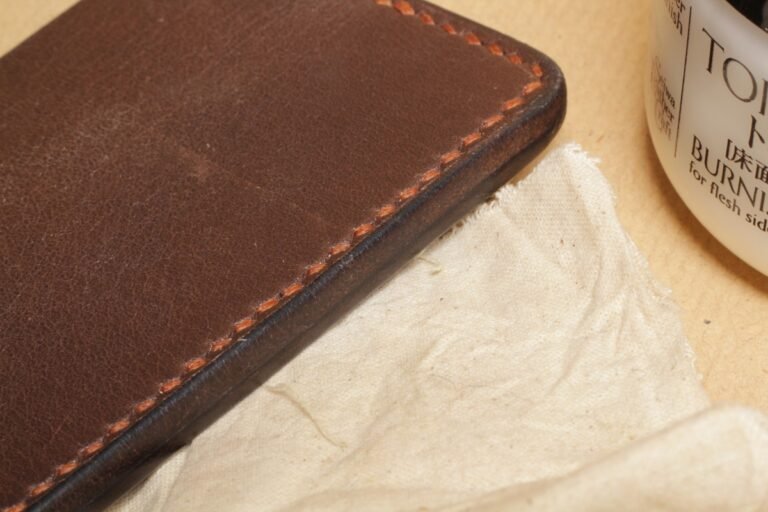
I prefer waxed leathercraft thread and may still pass it across a wax block on a longer stitch run simply to make it easier to pull. Test the thread, needle and hole combination on an offcut before starting the finished piece.
Frequently asked questions
What thread size is best for hand stitching leather?
For most hand leathercraft, 0.55mm suits fine small-goods work — card holders, slim wallets, and key fobs — at closer stitch spacings. A 0.65mm thread is the more versatile starting point for general stitching on wallet-weight to mid-weight leather. These two sizes cover the majority of hand leatherwork. The right choice depends on the leather weight, pricking iron spacing, and the stitch line appearance you are after.
What thread should I use for leather stitching?
Waxed polyester thread in 0.55mm or 0.65mm suits most hand leatherwork. It is consistent in diameter, does not rot, and runs smoothly through pricking iron holes without needing additional treatment. Linen thread is a traditional alternative that I use for repairs and deliberately traditional pieces. It is available waxed or unwaxed; Hideout Craft does not make a general consistency claim because I have only used Fil au Chinois linen.
Is 0.55mm or 0.65mm thread better for leathercraft?
Neither is objectively better — they suit different applications. 0.55mm produces a finer, more refined stitch line and suits closer stitch spacing and lighter leather. 0.65mm gives a bolder, more visible result and suits mid-weight leather and general-purpose work. If you are buying one size to begin with, 0.65mm in a good-quality waxed polyester is the more versatile starting point.
What happens if my leather thread is too thick for the stitch holes?
If the thread is too heavy for the holes made by the pricking iron, the needle will not pass cleanly and you will have to force it through, which distorts the leather around the hole. The finished stitch may look puckered or overstuffed. The fix is either to switch to a finer thread or use an iron that makes a larger hole. Spacing and hole size are not the same thing — wider spacing does not by itself make the hole bigger.