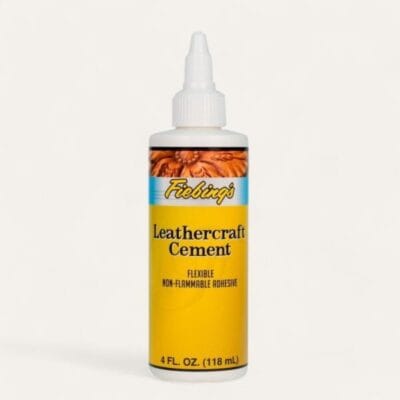
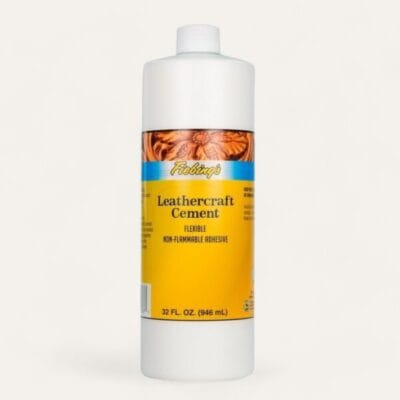
Fiebing’s Leathercraft Cement
Price range: £8.95 through £33.50Select options
This product has multiple variants. The options may be chosen on the product page

Leathercraft adhesives fall into three broad types: contact adhesives that bond permanently on contact, positioning adhesives that hold pieces in place before stitching without bonding permanently, and traditional leathercraft cement. Which one you need depends on the job — assembling layers for good, holding pieces steady while you stitch, or a simple, accessible all-rounder for general work.
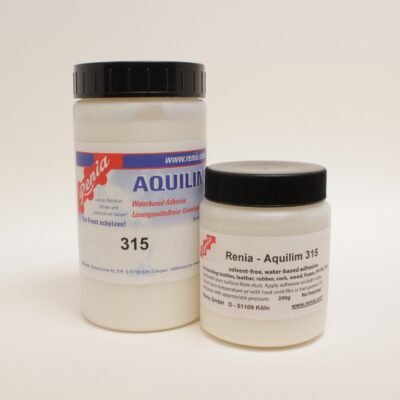
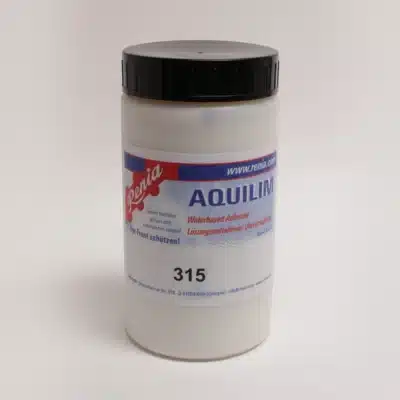
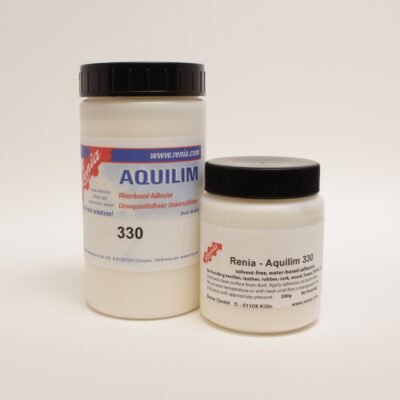
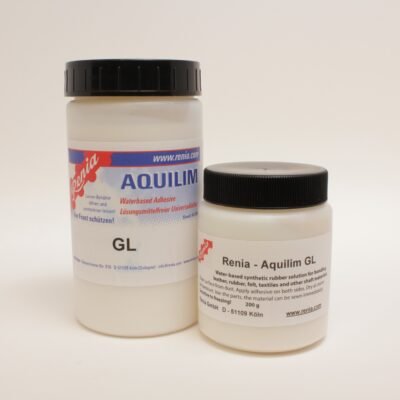
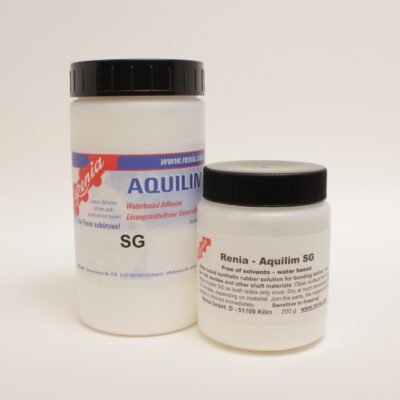
For most assembly work — wallets, bags, structured pouches, belts — a contact adhesive gives the strongest, most reliable bond. For leatherwork, Aquilim 330 is the newer formulation, developed specifically for leathercraft, with an open time of up to 8 hours. Aquilim 315 is the universal contact adhesive for leather and mixed-material work. Where the seam is going to be sewn through the bonded area, Aquilim GL keeps the adhesive film flexible so the needle passes cleanly rather than dragging through a rigid glue line. If you only need to hold pieces in position before stitching — not a permanent bond — Aquilim SG is the positioning adhesive: apply to one surface and it stays repositionable until the stitching does the structural work.
Renia Aquilim is water-based, which means lower odour and no solvent exposure concern for most workshop use — see our guide on water-based leather glue for more detail. Fiebing’s Leathercraft Cement is a water-based adhesive for leathercraft. It’s a reliable, accessible starting point for beginners and simpler assembly work, where a full professional adhesive range isn’t yet needed.
Applying adhesive properly makes as much difference as choosing the right one. A glue brush or a set of glue spreaders gives you an even, controlled coat rather than working straight from the tin — thin and even beats thick and heavy every time, since over-application doesn’t improve the bond and can cause squeeze-out at the joint. Follow the application and joining instructions for the adhesive you choose.
If you’re not sure which adhesive suits your project, our full guide to choosing the right leather glue walks through contact adhesives, cement, and water-based options in detail, and the Renia Aquilim range guide compares all four Aquilim formulations side by side with a complete how-to and FAQ.
Quick selection: leather and other absorbent materials → Aquilim 330. Leather with mixed materials (cork, foam, textile, felt) → Aquilim 315. Stitching through the bonded area → Aquilim GL. Positioning only before stitching → Aquilim SG. Simple, accessible start → Fiebing’s Leathercraft Cement.
As a rough guide by task: gluing wallet or bag panels before stitching calls for a contact adhesive (Aquilim 315 or 330); holding a lining or interior panel steady while you sew calls for a positioning adhesive (Aquilim SG); and any seam where the needle passes through the glued area calls for Aquilim GL specifically, so the stitch channel doesn’t close over. Aquilim 315 and 330’s standard two-sided method joins once the film is transparent; GL and SG use their own fixing instructions. Fiebing’s Leathercraft Cement is joined while wet. Do not apply one drying time to the whole range.