How to Burnish Leather Edges with Tokonole
Quick answer: To burnish leather edges with Tokonole: cut the edge cleanly, bevel both sides with an edge beveller, sand through medium and fine grit wet and dry paper, apply a small amount of Tokonole (less than you think you need), and burnish immediately with firm back-and-forth strokes. The friction compresses the fibres into a smooth, dense edge. Repeat as needed; stop when the edge is compact and consistent.
Tokonole is a popular edge burnishing compound made by Seiwa. Used correctly, it helps produce smooth, dense, well-finished edges on vegetable-tanned leather. This guide walks through the complete process — from preparation through to a finished edge — and covers the practical details that affect the result.
Before you apply Tokonole
The most important thing to understand about Tokonole — or any edge burnishing compound — is that it cannot fix poor preparation. The edge must be properly prepared before the compound is applied.
Cut the edge cleanly. A sharp blade in a single deliberate pass produces the best starting edge. Ragged or fibrous cuts require more sanding and are harder to finish cleanly.
Bevel both sides of the edge. An edge beveller removes the sharp corner from the top and bottom edges of the leather. This is what allows the edge to burnish into a rounded, smooth profile. Skip this step and the edge stays flat and square-profiled regardless of how much compound is applied.
Sand thoroughly. Use wet and dry sandpaper, working from a medium grit through to a fine grit, along the full length of the edge. The edge should feel noticeably smooth — almost silky — by the end of the sanding stage. Rough edges that have not been properly sanded will not burnish well even with Tokonole.
Choosing the right Tokonole colour
Tokonole is available in clear, black, and brown. Clear suits natural and light-toned leathers. Brown suits tan, chestnut, and mid-toned leathers where a natural edge colour would look right. Black suits dark leather and pieces with black or very dark edges.
Using the correct colour prevents the edge from appearing lighter than the surrounding leather, which can look unfinished on darker pieces. On natural vegetable-tanned leather, clear is usually the right choice.
Application
Apply a small amount of Tokonole to the prepared edge using a finger, a piece of dowel, or an applicator. The key word is small. Tokonole is effective in thin application — loading the edge with compound creates a wet, slow-drying surface that does not burnish well.
Work the compound along the edge so it covers the full length and both bevelled corners, but do not let it pool. The edge should look slightly damp, not saturated.
Burnishing
Begin burnishing immediately, before the compound has time to dry. Use a wooden burnisher, a smooth dowel, or the grooved section of a purpose-made burnishing tool. Work with firm, consistent back-and-forth strokes along the full length of the edge.
The friction creates gentle heat, which helps the fibres compact. You should feel the edge become firmer and denser under the burnisher, and the surface should begin to look smoother and slightly shiny as the fibres compress.
Work in short passes along the full edge rather than concentrating on one section at a time. This produces a more even result across the length.
Repeat stages if needed
On some leathers and for a denser finish, one application is not always enough. Allow the edge to dry partially after the first pass, assess the result, and if needed apply a second thin coat of compound and burnish again. Each stage builds on the last.
Stop when the edge is compact, smooth, and consistent. Continuing to work a dry edge with force will not improve it further and can damage the surface.
What good results feel like
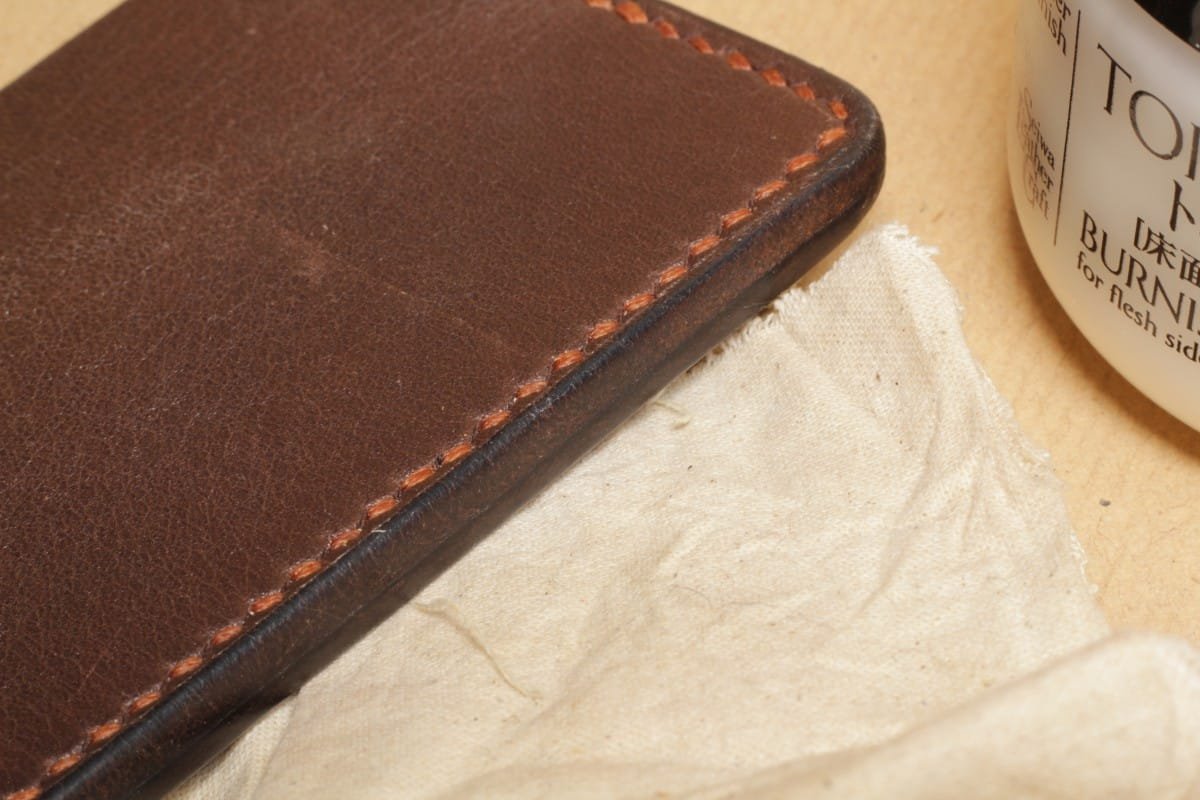
A well-burnished edge on vegetable-tanned leather feels firm and smooth to the touch. It should have no loose fibres visible, no flat-topped square profile, and consistent finish from one end to the other. The slight sheen from Tokonole gives the edge a clean, finished appearance without looking lacquered.
If the edge is still rough or patchy after following this process, the most likely cause is insufficient preparation — particularly sanding — before the compound was applied. Go back to that stage, not to applying more product.
Frequently asked questions
How do you use Tokonole on leather edges?
Prepare the edge first: cut cleanly, bevel both sides with an edge beveller, and sand thoroughly from medium to fine grit. Then apply a small amount of Tokonole using a finger or applicator — just enough to make the edge look slightly damp. Burnish immediately with firm, consistent back-and-forth strokes using a wooden burnisher or smooth dowel. Repeat if needed. The edge is done when it feels firm, smooth, and has no loose fibres.
How much Tokonole should you apply to leather edges?
Less than you think you need. Tokonole is effective in thin application — a small amount worked in properly compresses the fibres far better than a heavy coat sitting on the surface. Apply just enough to make the edge look slightly damp, not wet or saturated. Too much compound creates a slow-drying, difficult-to-burnish surface, and may ball up or look patchy when worked.
Can you use Tokonole without sanding the leather edge first?
The burnishing step can technically be done without sanding, but the result will be worse. Sanding prepares the fibre surface so the compound can penetrate and compact effectively. On an unsanded edge, the rougher fibres resist burnishing and the result is often patchy or still rough after the compound is applied. Sanding through medium and fine grit before applying Tokonole gives the compound the best surface to work on.
What do you use to burnish with Tokonole?
A wooden burnisher is the standard tool — either a purpose-made burnishing tool with a grooved channel for the edge, or a smooth wooden dowel of an appropriate diameter. The goal is firm friction along the edge without scoring or marking the leather surface. A grooved burnisher that holds the edge in the channel is particularly useful for getting consistent contact across the full edge profile.