Tokonole vs Gum Tragacanth: Which Should You Use?
Quick answer: Tokonole and Gum Tragacanth are both water-based edge burnishing compounds for vegetable-tanned leather. Tokonole gives a slightly more polished, consistent result and is available in clear, brown, and black to match the edge colour to the leather. Gum Tragacanth is the traditional product, giving a slightly drier, more natural finish. For most makers — particularly beginners — Tokonole is the more predictable starting choice.
Tokonole and Gum Tragacanth are both used for burnishing leather edges and smoothing the flesh side of vegetable-tanned leather. They work differently in some respects, and the choice between them is worth understanding — particularly because advice online tends towards strong opinions in both directions without always explaining the practical basis.
This guide covers what each product does, where it performs well, and how to make a useful choice.
What both products do
Both Tokonole and Gum Tragacanth are water-based compounds applied to the cut edge or flesh side of vegetable-tanned leather. They dampen and bind the leather fibres so that friction — from a burnishing tool — can compact them into a smooth, dense surface.
Neither product does the work on its own. The burnishing action is what finishes the edge. The compound is what makes the fibres workable. This is worth understanding because it means the process — preparation, application, burnishing — matters as much as the product choice.
Tokonole
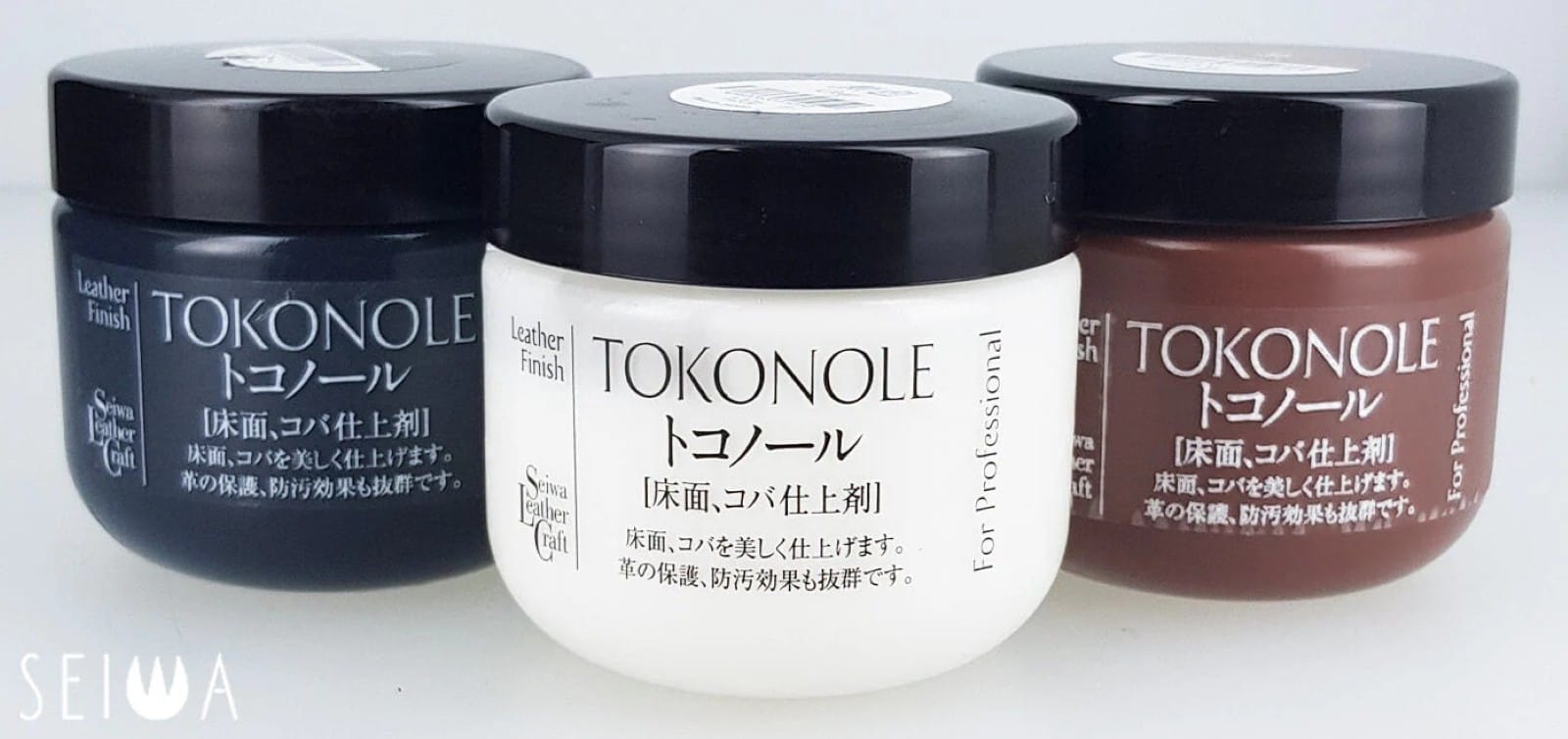
Tokonole is a Japanese product made by Seiwa. It is a thick, gel-like compound that applies cleanly and tends to behave predictably across a range of vegetable-tanned leathers. It gives a smooth, slightly lustrous result on properly prepared edges.
It can be used on the flesh side of the leather as well as the edge, which makes it useful for taming loose fibres and improving the surface where lining work is not used. Applied sparingly and worked in with a burnisher, it gives a clean, controlled result.
Tokonole is available clear, black, and brown. The coloured versions allow the edge and flesh-side finish to blend with darker leathers, which can improve the appearance on pieces where the edge or flesh side would otherwise show as a different tone from the grain surface.
For most makers, particularly those starting out, Tokonole is the most accessible and predictable of the two products. Hideout Craft stocks Seiwa Tokonole in clear, black and brown, ready to ship from UK stock.
Gum Tragacanth
Gum Tragacanth is a traditional natural product derived from Astragalus plants. It has been used in leatherwork for a very long time and remains a legitimate choice for edge burnishing and flesh-side treatment.
In use, it is slightly thinner than Tokonole and behaves somewhat differently on the edge — some makers find it gives a slightly dryer, more natural finish, while others find Tokonole slightly easier to work with on a wider range of leathers.
Fiebing’s Gum Tragacanth is the most widely available form, sold in a liquid that is applied directly to the edge or flesh side. The broad sequence is similar — prepare the edge, apply sparingly and burnish — but follow the instructions for the exact product and test it on the leather first.
The real difference
The honest answer is that for most vegetable-tanned leathers, both products will produce good results when the process is correct. The preparation stage — clean cut, proper bevel, thorough sanding — matters more than the choice of compound.
The practical differences are:
- Tokonole gives a slightly more polished, denser finish on most leathers and is somewhat more forgiving in application.
- Gum Tragacanth is a traditional product that some makers prefer for a more natural finish or because they prefer working with natural materials.
- Tokonole coloured versions give the option to match the edge finish to the leather tone — this has no equivalent in standard Gum Tragacanth.
Testing is always the right answer
Different leathers respond differently to both products. A test on scrap from the same piece of leather — applying each product and burnishing to the same point — will tell you more about what works on that specific leather than any general comparison. This is particularly true on leathers that are softer, more oily, or have been treated with a surface finish.
Use whatever produces the best result on your leather, with your process. There is no single correct answer that applies to every situation.
Frequently asked questions
What is Tokonole used for in leatherwork?
Tokonole is used to burnish the cut edges of vegetable-tanned leather and to treat the flesh side (rough inner surface). Applied sparingly and worked in with friction from a burnisher, it binds and compresses the leather fibres into a smooth, dense, slightly polished surface. It is available in clear, brown, and black versions to match different leather tones.
Is Tokonole or Gum Tragacanth better for leather edges?
For most makers, particularly beginners, Tokonole is the more consistent and predictable choice. It gives a slightly denser, more polished finish and the coloured versions allow the edge to be matched to the leather tone. Gum Tragacanth is a traditional product that produces a slightly drier, more natural result and is preferred by some makers for heritage or saddlery work. Both produce good results on properly prepared edges; the preparation matters more than which product is chosen.
Can you use Tokonole on any leather?
Tokonole is designed for vegetable-tanned leather, where it performs well. On chrome-tanned leather — which has a different fibre structure — burnishing compounds do not compress the fibres in the same way and typically will not produce the same result. For chrome-tanned leather, edge paint or a wax-based sealant is generally more appropriate.
What does Gum Tragacanth do to leather?
Gum Tragacanth is a water-based liquid compound derived from Astragalus plants. When applied to the cut edge or flesh side of vegetable-tanned leather and worked in with friction, it binds and compresses the fibres in the same way as Tokonole. The resulting finish is slightly drier and more natural-looking. The process is identical: apply sparingly, burnish immediately, repeat as needed.