Choosing Leather Thread – Linen, Polyester, and What Holds
Thread is not the most glamorous topic in leathercraft. It should be. It is what holds everything together.
The wrong thread for a project does not always fail immediately — but it often fails eventually, and usually in a way that reflects on the maker rather than the material.
Linen vs Polyester — The Real Difference
This debate gets more attention than it deserves, partly because it has become tangled up with tradition versus modernity in a way that is not always useful.
Polyester is strong, consistent, and highly resistant to moisture, abrasion, and UV. For anything that is going to work hard — a belt worn daily, a bag carried in all weather — polyester is what I reach for. It does not absorb moisture. It does not degrade under repeated wet-dry cycles. It holds colour well and performs reliably over time.
Linen is traditional, historically accurate, and when waxed properly has excellent grip in the stitch. For restoration work on older pieces it is often the right choice — it matches the character and age of the work. For pieces built in a deliberately traditional style, linen makes sense.
My honest position: I am a traditionalist when it comes to the craft, but not where it costs the finished piece its longevity. Most people will never know which thread was used. What they will know, eventually, is whether the seam held.
Thread Sizing — Getting It Right for Your Iron
Thread sizing is one area where beginners often guess rather than match, and it shows in the finished seam.
The thread needs to fill the hole cleanly without forcing it. Too thin and the stitch looks lost in the hole. Too thick and you are fighting the leather to get the needle through.
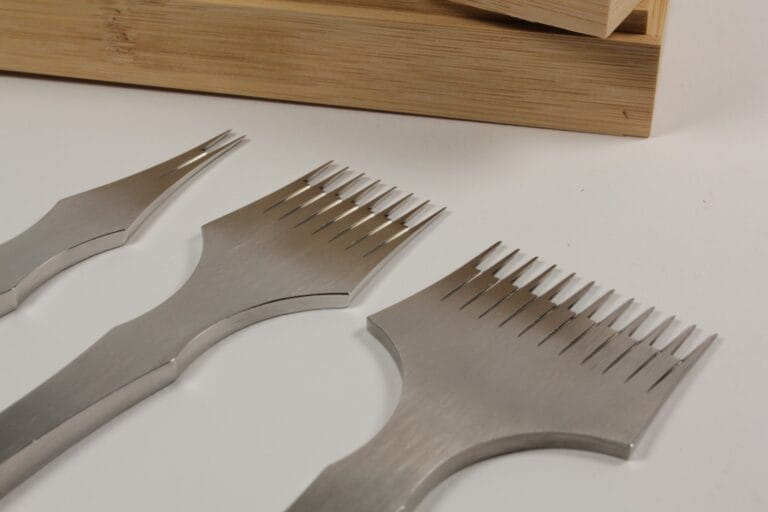
For 3.85mm spacing I use 0.55mm thread as my default. It sits well in the hole, locks cleanly, and looks right at that spacing. I sometimes step up to 0.65mm on heavier leather when I want a slightly more substantial stitch.
For 2.7mm spacing I drop to 0.45mm, sometimes 0.55mm depending on the leather thickness. The tighter spacing needs a finer thread to read well and to pass through cleanly.
The relationship between iron spacing and thread size is not arbitrary. They work together as a system. Matching them properly is one of the things that separates a seam that looks right from one that looks almost right.
Thread, Spacing, and the Look You Are After
If you have watched beginner leathercraft videos you will have noticed a lot of bold stitching — wide spacing, thick thread, pronounced holes. It photographs well, and for some pieces — heavy rustic work, saddlery — that is exactly right.
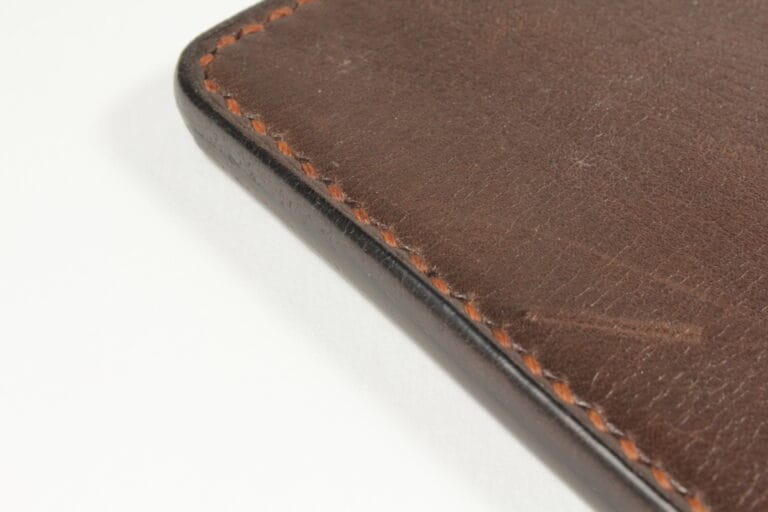
But as you develop your eye you start to want more control over what the seam looks like. Finer spacing with finer thread produces a noticeably more refined result. The kind of stitching you see on quality leather goods where the seam is present but not the dominant feature. Tighter, more precise, more controlled.
Neither is better. They are deliberate choices that suit different work. A wallet for everyday carry might suit fine, close stitching. A workman’s belt might suit something bolder. The point is that the iron spacing and thread diameter are what give you that control. You cannot achieve refined stitching with a wide-pitch iron and heavy thread — and bold stitching with a fine iron and fine thread will look out of place.
Work out what you want the seam to look like. Then choose the tools that make it possible.
What I Stock and Why
I stock Artisan Soul polyester thread in 0.55mm as my core range. The word “budget” gets misused in this context — Artisan Soul is not cheap in the sense of being inferior. It is consistent, strong, and I have never had a quality issue with it. The colour holds. It does what thread needs to do, reliably.
It simply costs less than some premium European brands. That does not make those brands better in any meaningful practical sense for most leatherwork. I use Artisan Soul in my own work. If I had a problem with it, I would not stock it.
Artisan Soul waxed polyester thread — 0.55mm, 39 colours
Pre-Waxed vs Waxing Your Own
Most quality polyester thread comes pre-waxed or runs smoothly enough not to require additional waxing.
Linen thread traditionally benefits from additional waxing — beeswax drawn along the thread before stitching. It adds grip in the hole, reduces drag, and helps the thread lie flat after each stitch is pulled through. If you are using linen and not waxing it, you will notice the difference. The thread catches differently, tension is harder to maintain consistently, and the finished stitch can look slightly ragged compared to properly waxed linen.
Pure beeswax block for thread waxing
Needles and Thread Together
Thread choice and needle choice are connected. I use John James harness needles — size 002 and 004 — for the majority of my stitching. Blunt-tipped, consistent in eye size, and reliable across long sessions.
The eye of the needle needs to accommodate the thread without forcing it. If you are pushing thread through an eye that is too small, the thread is being stressed before it even enters the leather. Match your needle to your thread the same way you match your thread to your iron. The whole system works together or it introduces friction at every stage.
John James saddlers harness needles — sizes 001, 002 and 004
Frequently Asked Questions
What thread size should I use for leathercraft?
For most leatherwork with 3.85mm pricking irons, 0.55mm waxed polyester thread is a reliable starting point. For finer spacing at 2.7mm, drop to 0.45mm. For heavier leather and wider spacing, consider 0.65mm.
Is linen or polyester thread better for leather?
Both are capable of producing excellent results. Polyester is stronger, more moisture-resistant, and more durable under hard use. Linen is traditional and suits restoration work and traditional-style builds. For anything that needs to perform daily — polyester. For traditional craft and repair work — linen.
What is waxed thread for leathercraft?
Waxed thread has been coated or drawn through wax to reduce friction as it passes through leather and to help it lie flat after each stitch is pulled tight. Most quality polyester thread comes pre-waxed. Linen thread benefits from additional beeswax applied before stitching.
How long should I cut my thread for saddle stitching?
Cut thread approximately 3.5 to 4 times the length of the seam you are stitching. Too short and you run out mid-seam. Too long and the thread becomes unmanageable and prone to kinking.
Why does my thread keep twisting when I stitch?
Thread twists naturally as it passes through holes and is pulled tight. Periodically allow your needles to hang free so the thread can unwind, and stitch with a consistent pull direction. Twisted thread causes uneven tension and a messy stitch line — it is worth managing rather than ignoring.