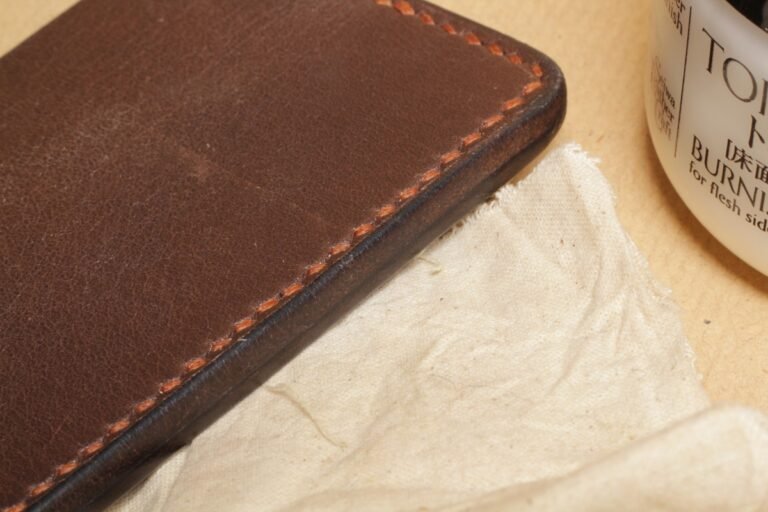
Why Your Leather Stitching Looks Uneven and How to Fix It
Quick answer: Uneven leather stitching almost always has a specific cause rather than being a general skill problem. The five most common causes are inconsistent pricking iron holes, unequal tension between the two needles, thread twist, a shifting stitch angle, and a thread-to-hole mismatch. Work through each cause systematically and the problem will narrow down quickly.
Uneven stitching is the most common complaint from beginners, and in most cases it has a specific cause rather than being a general skill problem. This guide works through the most frequent causes and what to do about each of them.
The holes are not consistent
If the stitch holes are uneven in spacing, depth, or angle, the thread will never sit consistently regardless of how carefully you stitch. The holes are made before the stitching starts, and the stitch line can only be as good as the preparation underneath it.
Check that the pricking iron is being held straight — perpendicular to the surface of the leather, not angling forward or back. Check that the leather is on a firm, flat surface that does not give under the impact of the mallet. Check that the iron is being struck squarely and with consistent force. If the iron tilts, the holes tilt with it.
A stitching pony (we stock Kevin Lee) is useful here because it holds the work at a consistent angle and both hands are free to control the iron and mallet properly.
The tension is different on each side
Saddle stitching uses two needles. Each needle pulls thread through the same hole from opposite directions. If one hand pulls harder than the other, the thread sits unevenly — too tight on one side, too loose on the other.
Pay attention to which hand is pulling more. The goal is the same firm, deliberate pull on both sides for every stitch. It helps to pause and feel the resistance as you pull rather than stitching on autopilot.
The thread is twisting
Thread twist is a common cause of irregular stitch appearance. Waxed polyester thread can twist during stitching, especially if the needle is rotated in the same direction repeatedly as you pass it through the hole. This builds up tension in the thread and causes the stitch to look kinked or to sit at an angle.
Let the needles hang free periodically and allow the thread to unwind itself. If you notice the thread twisting significantly while stitching, stop and straighten it before continuing.
The angle of the stitch is changing
In saddle stitching, the thread should cross consistently at the same angle in each hole. If your hand position changes as you move along the stitch line — particularly when you shift how you hold or support the work — the crossing angle can shift with it, causing the stitches to look irregular even when the tension is consistent.
A stitching pony helps by keeping the work in a fixed position. Without one, be deliberate about keeping the same needle path and crossing angle on every stitch.
The thread does not suit the hole size
If the thread is too thick for the holes made by the pricking iron, you will have to force the needle through, which distorts the leather around the hole and creates irregular stitch gaps. If the thread is too fine for the spacing, it can sink into the hole rather than sitting on the surface cleanly.
Match the thread weight to the pricking iron spacing and the leather. Finer thread suits closer spacing and lighter leather. Heavier thread suits wider spacing and thicker leather. If the needle is passing through easily and the thread is filling the hole cleanly without being forced, the combination is working.
The preparation was rushed
Poor edge cutting, uneven gluing, or layers that are not properly aligned before stitching all create problems that show up in the stitch line. A leather edge that is not cleanly cut pulls slightly at the stitch holes near the edge. Layers that have slipped out of position during gluing change the available depth for the stitch.
Most stitching problems that look like stitching problems are actually preparation problems. Work backwards from the result to find the real cause.
How to practise
Use scrap leather and stitch deliberately slowly. Look at each stitch as you make it. Is the tension right? Is the thread crossing consistently? Are the holes straight? It is much easier to correct a specific problem when you are focused on one thing at a time rather than trying to produce a finished piece as quickly as possible.
Good stitching becomes habitual with practice. The aim is to build a consistent rhythm so that the good habits take over from the bad ones.
Frequently asked questions
Why does my leather stitching look uneven?
Uneven hand stitching usually traces back to one of five causes: inconsistent holes made by the pricking iron, unequal pulling tension between the two needles, thread twist building up during stitching, a shifting stitch angle, or a mismatch between thread weight and hole size. Work through these in order — preparation problems are the most common root cause.
How do I get even tension when saddle stitching?
Pay deliberate attention to how hard each hand pulls after each stitch. Both needles should seat the thread with the same firm, controlled pull. A stitching pony helps by holding the work steady so both hands are free to focus on thread control. Slowing down and checking tension on each individual stitch while learning is more effective than stitching quickly and hoping the result evens out.
Why is my leather thread twisting during stitching?
Thread twist usually builds up when the needle is rotated consistently in the same direction as you pass it through the hole. Let the needles hang free periodically and the thread will unwind itself. If you notice significant twist building up mid-run, stop and straighten the thread before continuing.
Can poor pricking iron holes cause uneven stitching even if my technique is correct?
Yes — the stitch line can only be as consistent as the holes underneath it. If the pricking iron is held at an angle, the holes will be angled. If mallet force varies, hole depth will vary. Even careful stitching cannot fully compensate for holes that are irregular in position or depth. Most stitching problems that look like technique problems are actually preparation problems.