The Traditional Approach to Hand Stitching Leather
Choosing the Right Leather and Building Proper Foundations
Written by Magnus Enslin
Founder, Hideout Craft
There is something about stitching leather by hand that slows the mind down.
It demands patience. It does not reward rushing. You sit, you mark, you pierce, you pull thread through one stitch at a time. There is rhythm to it, and once you find it, the work becomes almost meditative.
I don’t use a sewing machine in my own work. Not because machines are wrong — they are efficient, consistent, and have their place — but because I am drawn to the traditional method. Hand stitching keeps me close to the material. It forces me to understand what the leather is doing rather than overpowering it.
When I first started, I made many mistakes. Crooked lines. Uneven tension. Poor skiving. But the biggest confusion wasn’t stitching technique.
It was leather.
Understanding Leather Before You Thread a Needle
In the beginning, I struggled to tell the difference between vegetable-tanned leather and chrome-tanned leather. I bought what looked good, or what was affordable, and only later realised that different leathers behave very differently once you start cutting and stitching.
That early confusion is common.
If you want to learn traditional saddle stitching properly, the leather you choose matters more than most people realise.
Why Beginners Should Start with Vegetable-Tanned Leather
Vegetable-tanned leather behaves in a way that teaches you.
It marks clearly with a wing divider.
It cuts cleanly when your blade is sharp.
It holds a stitch line.
It burnishes.
It develops patina over time.
When you pierce it with an awl or iron, the hole keeps its shape. The thread sits where it should. The leather firms slightly around the stitch and supports it.
For someone learning, that predictability is important.
Chrome-tanned leather is softer and often more flexible, but it behaves differently. It doesn’t burnish in the same way. It doesn’t darken naturally when worked. Many pieces are finished or coated, and to a beginner it can sometimes feel almost plastic.
Stitches can look inconsistent even when your technique is improving. Edges may refuse to behave. The leather might stretch in ways you weren’t expecting.
That doesn’t make chrome-tanned leather inferior. It simply makes it less forgiving when you’re trying to understand the fundamentals.
Vegetable-tanned leather responds to what you do. It shows you your mistakes clearly — which is frustrating at first, but invaluable in the long run.
Acknowledging the Craft
When I was trying to make sense of saddle stitching properly, I returned repeatedly to the work of Nigel Armitage. His demonstrations of traditional hand stitching were some of the clearest I could find.
What stood out to me wasn’t just the mechanics of the stitch. It was the patience. The posture. The emphasis on consistency rather than speed.
Watching that level of control changed how I approached the craft. Hand stitching stopped being about finishing a project and became about building it properly.
That mindset shift matters.
Choosing the Right Thickness (Especially Without a Splitting Machine)
Most beginners do not own a leather splitter. I didn’t. That means choosing the correct thickness from the start is critical.
Thickness affects more than strength. It influences:
- How the stitch sits visually
- How the leather folds
- Whether edges become bulky
- How forgiving your spacing appears
For small goods such as card holders or slim wallets, around 1.2–1.6 mm is often manageable. For slightly more structured pieces, 1.6–2.0 mm can work well. Belts and load-bearing pieces may sit closer to 3.0–3.5 mm depending on the design.
If the leather is too thick, stitching becomes forced and heavy. If it’s too thin, the piece can feel weak or collapse at the edges.
You cannot fix poor thickness choice with better thread. The foundation has to be right.
Hand Stitching Is Not Just About Stitching
Most people jump straight to, “How do I saddle stitch?”
I did the same.
But stitching is only one part of the craft. It’s the visible part — the bit everyone notices — but it sits on top of everything else.
Before you can stitch well, you need to learn:
- Pattern making
- Accurate cutting
- Marking straight lines
- Proper use of a pricking iron
- Skiving
- Blade stropping
If your pattern is even slightly out, the stitching will expose it.
If your edge isn’t straight, your spacing will look uneven no matter how careful you are.
And if your blade is dull, you will fight the leather instead of working with it. A dull blade doesn’t just produce poor cuts — it is dangerous.
Stropping becomes part of the routine. It is not optional maintenance; it is discipline.
Stitch Spacing — Finding What Feels Right
There is no single correct stitch spacing.
Some prefer very fine work. Others prefer bold, pronounced stitches.
I personally favour 3.85 mm spacing. It sits comfortably between fine and robust. It works across a range of projects and is forgiving without looking heavy.
But spacing is personal. It must suit your eye and your work.
Lay a test strip on your bench. Stitch a sample. Step back and look at it from a distance. Does it feel balanced? Does it match the scale of the piece?
That answer matters more than copying someone else’s preference.
Skiving — The Skill That Changes Everything
Skiving is one of the least glamorous skills and one of the most important.
Poor skiving leads to bulky folds, uneven layers, and difficult stitching. Clean skiving allows leather to fold naturally and layers to sit properly against one another.
It takes practice.
You will ruin pieces learning this. That is normal.
Keep your blade sharp. Work slowly. Learn how the leather thins under the blade rather than forcing it.
Once you understand skiving, construction improves dramatically.
Edge Finishing Comes After the Fundamentals
Beginners often obsess over perfect glass-like edges before mastering straight stitching or understanding proper edge finishing.
Edges matter. But they are the final stage.
If your patterns are accurate, your cuts are clean, your layers are skived correctly, and your stitching is straight, edge finishing becomes far simpler.
Good edges are usually the result of good preparation.
Embracing Imperfection in Leather
Modern retail often favours flawless, uniform leather.
But leather is not plastic.
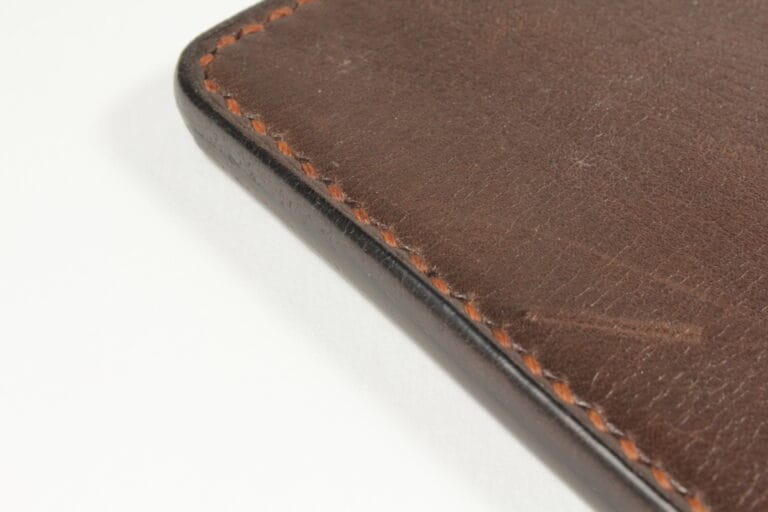
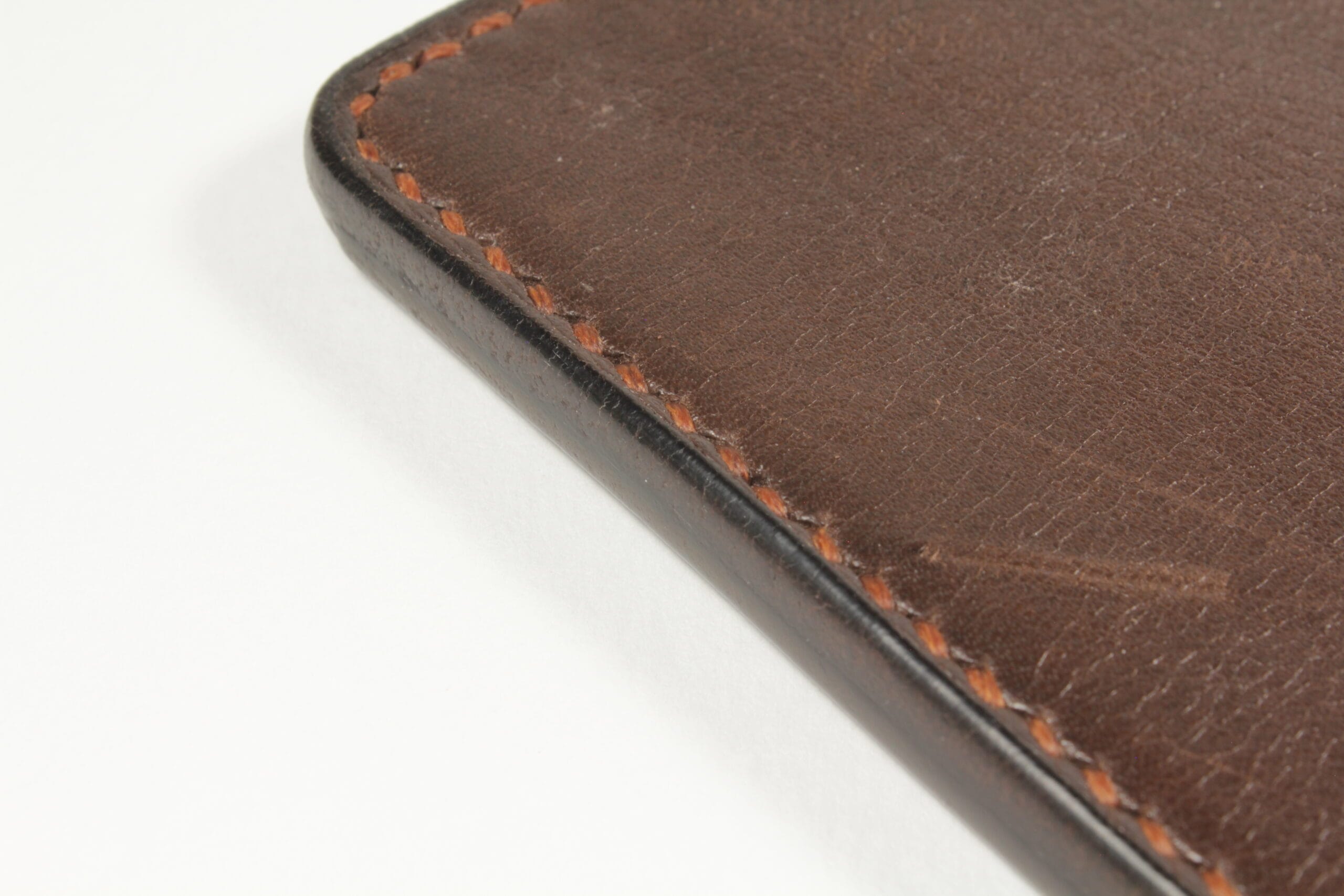
It carries marks. Grain variation. Scars. Small inconsistencies.
I prefer working with leather that shows signs of life. Those marks are part of the material’s story. They remind you that this was once living hide, not manufactured fabric.
When used thoughtfully, imperfect leather produces character that perfectly uniform hides sometimes lack.
If you approach leather expecting it to behave like a synthetic material, you will be disappointed.
If you approach it with respect, you begin to understand it.
Why I Continue to Stitch by Hand
Hand stitching is slower.
It will not compete with factory production speeds.
But it produces strong, repairable seams and visible craftsmanship. More importantly, it reinforces patience.
You cannot rush hand stitching without seeing the result in the seam.
And perhaps that is the point.
Traditional craft is not about nostalgia. It is about control, longevity, and understanding the material fully before asking it to perform.
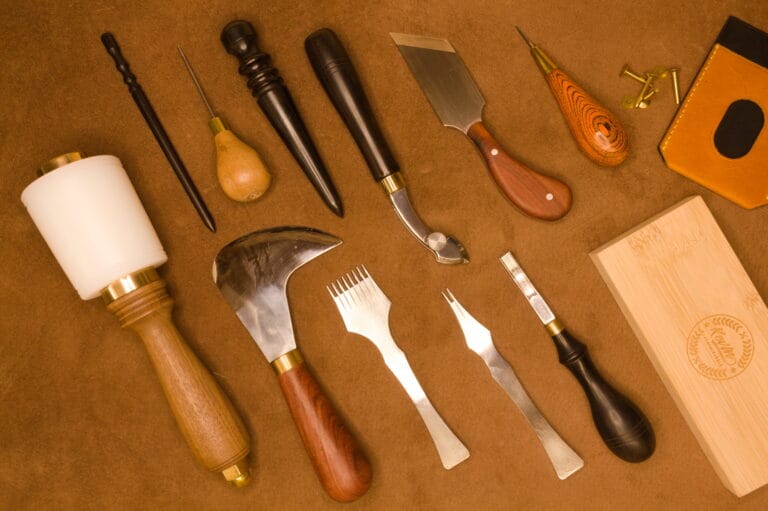
Tools matter — not because they make the work easier, but because they allow you to do the work properly.
Final Thoughts
If you are beginning your journey with hand stitching:
Start with vegetable-tanned leather.
Choose your thickness carefully.
Learn to cut straight.
Learn to maintain your blades.
Practice skiving.
Mark carefully before punching.
Speed will come.
Confidence will come.
But only if the foundations are sound.
Leather rewards patience.
And it remembers shortcuts.